Black vultures (Coragyps atratus) are a new world vulture endemic to South America, Central America, the Caribbean, and the southeastern U.S. Within the last 50 years, black vultures have expanded their range northward into the mid-western and northeastern U.S. At present, it is unknown what factors have caused this significant expansion, although climate change and increasing roadkill abundance may have some role (Buckley et al. 2020). Abundance is also increasing throughout their range at a rate of about 4.77% per year (Sauer et al. 2020). The geographic range expansion and increasing abundance of Black vultures has corresponded with increases in human-vulture conflicts, including property damage, cattle depredation, and hazards to aircraft.
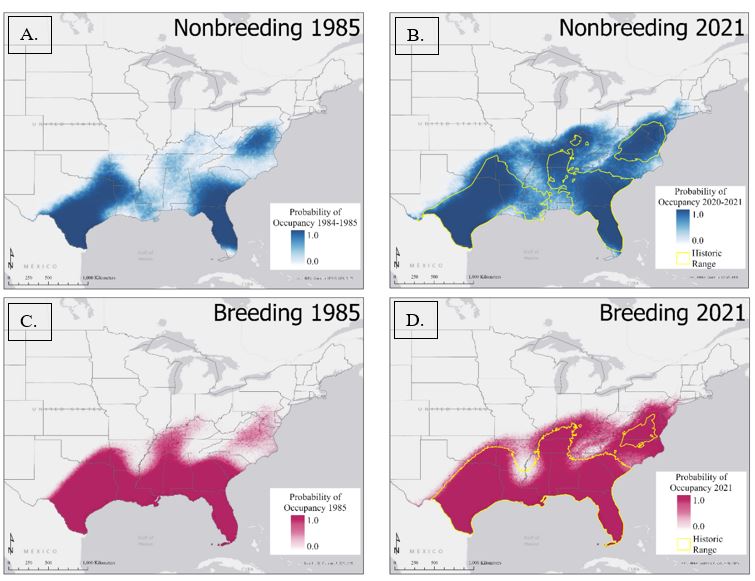
Jen Brown (MS 2024), in partnership with Clark Rushing, myself, and numerous state and federal partners, led our recently completed study to address the drivers of this expansion. This included using Breeding Bird Survey and Christmas Bird Count data to estimate black vulture breeding and wintering occupancy across the U.S. We found that winter occupancy was positively associated with difference in temperature and thermal uplift while there was no effect of these variables in the breeding season. This suggests that winter conditions could play an important role in limiting black vultures’ range, and with warming winter temperatures due to climate change, they are now able to occupy higher latitudes.
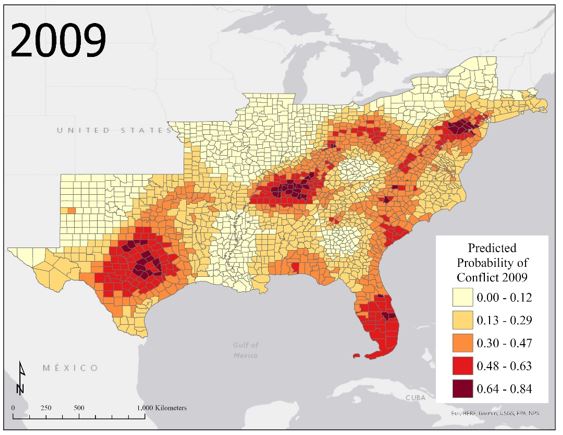
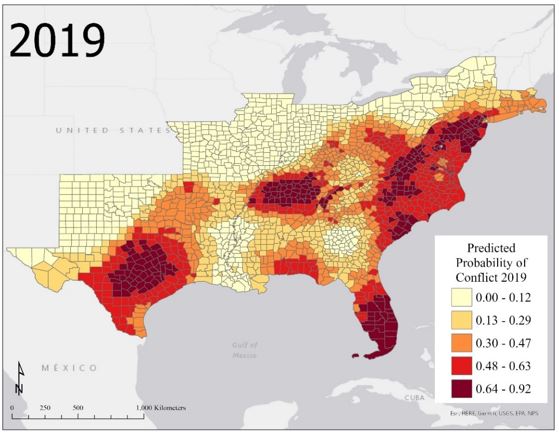
We next modeled human-vulture conflicts over time using mitigation data from the USDA Wildlife Services and USFWS Depredation Data. We found that probability of human-vulture conflict was positively associated with the proportion of developed open landcover, cattle density, electrical transmission line density, and black vulture breeding season occupancy
Lastly, we assembled the largest GPS dataset of black vultures ever to identify differences in black vulture resource selection across core and periphery populations. We found marked differences in resource selection between core and periphery populations, but these differences failed to explain range expansion. Black vultures in periphery populations exhibited weaker selection for distance to roads and landfills, and more strongly avoided high proportions of all landcover types. However, core and periphery populations demonstrated consistent selection for increased landscape richness. This ability by black vultures to use a variety of landscapes likely allowed them to closely track changing environmental conditions, suggesting that black vulture range expansion is likely driven by climate change and anthropogenic food subsidies rather than behavioral shifts.
 Kohl Wildlife Lab